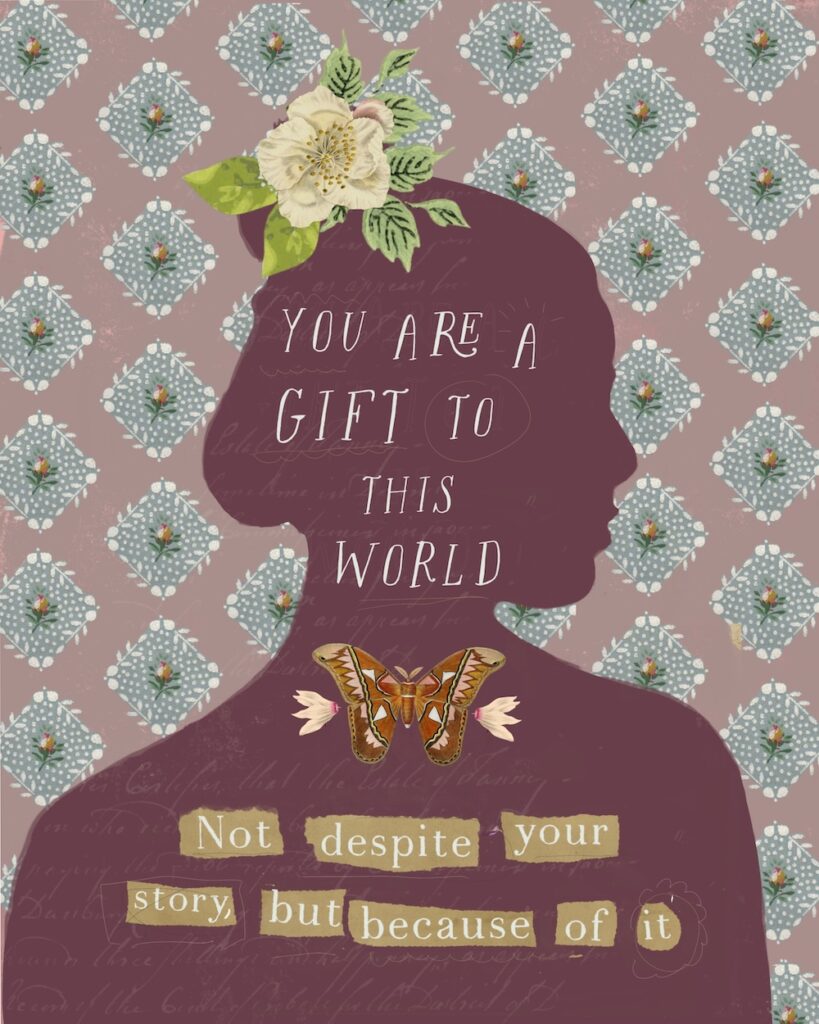
(New print, available here)
If my son True, now a teenager, had been born a girl, we would have named her Story. I think about that sometimes. How Story might have lived in our home, at the table with us, her name called across rooms. But maybe she was always meant to arrive another way. Through my art. Through the words I write and the longing I carry to make sense of things.
I have always loved stories, especially other people’s. Memoirs stack on my nightstand, pages underlined and corners folded. They remind me that I am not alone in the mess of being human. There is togetherness there, a collective belonging that feels ancient and familiar. When I read about someone else’s ache or wonder, I feel witnessed in mine.
I have not always been brave enough to share my own stories. Early teenager me was quick to laugh, quick to make friends, and yet always guarding the story. When I spent the night at friends’ homes, I dreaded the dinner tables. The cheerful questions from their parents about my family made my stomach twist: What do your parents do? Where does your sister go to school? What neighborhood did you grow up in? I could feel my face go hot as I tried to answer without saying too much. No, I don’t have a father. It’s complicated. Yes, I have an older sister. No, she’s not in school, but that’s also complicated. No, I haven’t lived in the same neighborhood or gone to the same school. There have been eight of them so far.
My family and my history were messy. I wanted to be like the other kids, the ones who seemed to belong to tidy, ordinary stories. I wanted to be like them, unremarkable in the best way. So I smiled, laughed at the right times, and offered half-truths. The shame I felt for my story burned quietly in my cheeks, and I learned to tuck it away.
When I started blogging in 2005, at the age of 30 and on the cusp of becoming an artist, the truth began to slip out almost accidentally. Each post felt like a small rebellion against the silence I had inherited. I wrote vulnerably, without much polish, and something in me started to breathe again. I found my writing voice, and the art I made alongside it was a potent, life-opening medicine for me. For a while, it felt like I had found a doorway into a truer version of myself. But slowly, I noticed my stories retreating again. Less blogging. Less writing. Less reflection. The quiet crept back in, inviting me away from exposure.
Now, at fifty, I am less interested in being careful. Something in me knows that telling my stories is an act of staying alive. Heartbeat. Inhale. Bravely own your story. Exhale. Maybe this is what midlife gives us: the permission to drop the armor, to look at our unedited selves and call it holy, like seeing our naked, aging bodies in the mirror and recognizing the absolute preciousness of our own lives.
Can we self-witness? Can we tenderly own our stories — the old ones, the new ones unfolding, the ancestral ones that live in our bodies — and meet ourselves there with love? I sometimes imagine my current self sitting beside that younger girl at a dinner table, her cheeks flushed red with embarrassment. I want to tell her that she does not have to hide. Her story is not a secret to protect. It is the map of how she found her way here.
We know what happens when stories stay unspoken. They live in the body, quiet and heavy, waiting. They twist themselves into shape, passed down through generations, unnamed but still felt.
But when stories find their way into the light, it is a miracle of a gift. When they breathe out through art, through conversation, through music, through therapy, through bodywork, through writing, they change form. They become medicine, a healing set in motion. Pain into compost, shame into belonging, silence into strength.
The truthiest truth I know is that our stories, with all their jagged edges and beauty and truth, are a gift to this world. Not despite what they hold, but because of it.